Monday, June 30, 2008

Like Nothing Else Going...

I've been a bit heavy on the place recommendations lately, so let me pass along a singer/songwriter whose work has been exclusively on shuffle on the old iPod for the last week and there's no sign of it letting up-- I adore him, and he goes by the name of Teitur.*


Credit for this discovery goes to a very dear friend of mine-- let's call him Adam-- and to be fair he told me about him back in March. However, it took me ages to get my act together and really give it a listen. Needless to say, I wish I had been more attentive ages ago.


Originally from the Faroe Islands**, he was first part of a little band known as Mark No Limits, but has met with much wider success for his solo work. He's got one album out in Faroese (which I think is pretty outrageously cool) and another two in english. Despite Celan's statement that poetry is not bilingual, I've got to say that Teitur proves him wrong with well-written, subtle and delightful lyrics and a brilliant orchestration.


Albums include Poetry and Airplanes (July 2003), Stay Under the Stars (September 2006), Káta Hornið (May 2007), and The Singer (April 2008). Poetry and Airplanes contains such gems as the song that first hooked me, Sleeping with the Lights On. Other personal favorites include Rough Around the Edges and the title track, though I don't know who I'm kidding, I'm basically addicted to this entire album. The lyrics are just so damn perfect, and if you don't find his voice genuine, then sir, you have no beating heart within you.


Stay Under the Stars has it's fair share of memorable lyrics as well-- "May our minds lose the battle / May our hearts win the war" for instance, from Don't Want You to Wake Up, and several others.


Despite the fact that I don't know what he's saying, Káta Hornið is very much in heavy rotation on the Baby. If anyone knows what he's saying, I'll bake you a whole batch of orange shortbread if you enlighten me!


*His name, in Old Norse, means 'happy' and that is precisely what his songs make me--how lovely is that!
**Equidistant from Iceland, Scotland and Norway, I think my perfect summer house might be in the Faroe Islands, and if the men are as lovely as Teitur's lyrics, I might stay for a winter or two as well.

Tuesday, June 10, 2008

Elgin!

Or: The Day That Never Ended.*


For the money, Elgin is not a bad idea. In fact, if you're into really interesting, ruined cathedrals with atmosphere and history spilling out of every nook and cranny, Elgin is for you! Just make sure you know what time the train comes and goes. In fact, you might want to tattoo it somewhere on your body, just to be safe. Especially if travelling on a Sunday. Just take my word on this one.

It isn't so obvious on a modern map, but for much of recorded history Elgin was isolated from the rest of Scotland; with the Cairngorms to the south and protected by two unbridged and often uncrossable rivers, the Spey to the east and the Findhorn to the west, Elgin really is in the middle of nowhere. This is a fact you will become keenly aware of should you miss the aforementioned trains.

Historians say that Elgin "probably" existed in 1040 when King Duncan's army met and lost to the infamous macbeth at Pitgaveney, a mile north east of the modern city. It was definitely a well-established hum for humanity by the time it was Chartered as a Royal Burgh by David I in 1136. By 1230 Elgin had also acquired a Royal Castle, built on the foundations of an earlier defensive structure, possibly the one in which Duncan died of his wounds in 1040. On the royal line, Richard I stayed in Elgin Castle when he visited the city in 1296 during one of his tours of suppression. For more on the Castle, stay tuned-- but for now, let's talk a little (or rather, quite large and ruined) cathedral!

Anyways, the Cathedral is a decent walk through a residential bit of Elgin, past some large palm trees in the center of a roundabout and then, poof! giant honking ruin. The first church on the grounds dates back to the 1200s, and was a cross-shaped building much smaller than the currently visible ruins. It was enlarged later in the same century, possibly following a fire, which yeilded the main church, 280ft in length, taller than the original and with a new choir and an octagonal chapter house. After St. Andrews it was the second largest cathedral in Scotland.

Some badly judged local politics led to the burning of the Cathedral (and much of the rest of Elgin as well) in 1390, by the Wolf of Badenoch, otherwise known as Alexander Stewart, the younger son of Robert II. Bishop Alexander Bur had apparently caused him to to be excommunicated for marital infidelity, and this was his way of getting even. If you ask me, burning a church isn't the best way to get back in with the church, but whatever.

The destruction was followed up by two hundred years of off-and-on rebuilding and adding-on. More work was needed after the collapse of the central tower in 1506, and the west front and chapter house both had some work done around the same time.

Sadly, the Lantern of the North, as Elgin Cathedral is still affectionately known, was one of the many casualties of the 1560 reformation. Unfortunately, it was a blow from which the mightly old building would never recover, as the cathedral fabric soon began to suffer. The lead roofs and the cathedral bells were pulled down and in 1637 the choir roof blew down in a gale. The cathedral still saw occasional use, but it was never enough to justify any repairs. Much of the inside was robbed out, including the destruction of the rood screen for firewood, which breaks the heart if you think about it for long enough.

In the early 1800s there was finally some interest in preserving what hadn't already been lost forever. In 1807, John Shanks, "a drouthy cobbler" was appointed keeper of the cathedral and his single-handed efforts in the clearing of collapsed masonry led to the preparation of a report seeking to highlight the steps required to stabilise the ruin and improve the cathedral grounds.

Modern visitors are left imagine what the cathedral must have looked like in its day. However, there's still plenty to marvel over. Sadly, little remains of the nave, though the ruins of the inner walls are of full height where they abut the towers, showing that it was two stories high. The two transepts represent the most complete part of the first church, and they also had two stages. Nothing remains of the great central tower, but two stone figures, one of a bishop and another of a knight are now on display in the south-east corner of the nave. They originally sat in large niches high up on the western angles of the tower.

Of the cathedral church, the choir and presbytery are the most complete parts remaining. These were rebuilt in the late 1400s. The aisles and chapels flanking the choir have been altered, but the vaults that cover them are still essentially as built after 1270. The tomb of Bishop John of Winchester, lord bishop of Moray which is found here, is the most complete in the cathedral. There are some truly unusual tombstones, take your time and look closely!


Even if you arrive after the cathedral is officially closed for the day, there are pleanty of sights to be seen and photos to be gleaned by a walk around the perimeter. While I'm pretty happy with most of the pictures I took of the place, they comepletely and totally fail to capture the sheer SCALE of the place. I suppose you'll just have to see it with your own eyes! ;)


If you've still got some time to kill while in Elgin (and considering it's Elgin, you just might), take a walk over to Lady Hill Monument. There's not a whole lot left of the castle today, though Lady Hill on which it stood remains a prominent viewpoint. Since 1839 it's been the home of the 80ft high Duke of Gordon Monument with a statue of the fifth duke glowering down on Elgin. Maybe he missed his trains as well.

The base of Lady Hill is perfectly semmetrical and really quite lovely, and you could totally pull a Rocky up the steps if you really want. To the right of the undeniably phallic Gordon tower...... one will find some rocky, castley bits. Feel free to impersonate a mountain goat on some really, REALLY old castle. I certainly enjoyed it! Just remember, you've got to walk back down the hill you climb. :)


*-- If you want the FULL story on why this epic day was the "day that never ended" you'll have to find me in person, soften me up with at least three pints or two double whiskey and lemonade, and then-- and only then-- ask me about it.

Wednesday, June 4, 2008

Huntly Castle

If you're ever in the area, and you want to see a decently well-preserved castle with incredible history, let me recommend Huntly:

It's a few stops down the line if you take the train out of Aberdeen, the day return is less than you'd pay for a nice bottle of wine, and if you ask me it's a pretty good way to spend a day. Some may disagree. On this particular day, a friend of mine (who just happened to be buying his ticket down to Glasgow for a Lads' Weekender at the same time we were in the que)-- let's call him Dear-- asked where we were going. The conversation ran a little like this:

Dear: "So, where are you ladies off to?"
Me: "Huntly, just for the day."
Dear: "... Why?!"
KayPea: "There's a castle there!"

And so there is. It's a comfortable walk through the very quaint town of Huntly to the Castle from the station. The approach is lovely, and as the Castle grounds butt up against the other great Scottish landmark-- a golf course-- there's lots of pretty green spaces about. Large parts of the Castle are labeled with helpful little signs, and there's clear distinction between the different ages of renovation within the grounds.


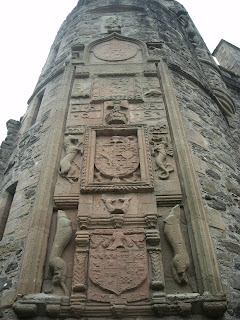
Some of the highlights include a fragment of the medieval road leading to the old gate:


The very unique frontispiece:


The remains of the stable (the differentiation in the floor shows the size of the stalls, and the very small size of the horses bred in the region at that time):


The labeling along the front of the "recent" addition:


The intricately carved mantlepieces, some of which are remarkably intact:


Here's a lovely shot of KayPea doing what she does best-- recording her stay in Scotland frame-by-frame with her lovely camera! ;)

Though, to be fair, the view from the very top of the round tower was definitely worth snapping for posterity...


For a modest fee (even more modest if you join up for a year-long membership in the Heritage Trust) you gain entry to the grounds and this lovely chunk of history. So do it!

Wednesday, May 7, 2008

What a glorious Tuesday!

For those of you not in the British Isles today, let me tell you-- you missed it. Sunshine like silk, a light breeze, fresh air, blooming flowers, sunlight on water... people live for days such as these.

So what did Miss Melville do with it?

Took the train to Inverness and a bus and a boat out to Loch Ness!

Lawd, what a lovely day! The ride out along the rails took about 2.25 hours, delivering unto our happy eyes field after pasture of woolly, wonderful sheeps and sheeplings. These little balls of fluff munched sweet green grass or frolicked as we passed stone fences and small creeks. Genuinely enjoyable. After arriving in Inverness, a pleasant town all on its own-- though about 10 degrees Fahrenheit cooler than our point of departure in Aberdeen-- we wandered down to the tourist information storefront, where my traveling accomplice, let's call her M, purchased some Scottish swag and cards of the post persuasion. Then it was off to a woollies shop for more touristy purchases, and then the bus depot where we ate sandwiches in the aforementioned sunshine and shared a chocolate bar. Yes, I packed a little "mom bag" as M called it, with sandwiches and green grapes and granola bars and some chocolate and dried cranberries (unsweetened, of course) and a totally unnecessary umbrella and some band-aids, but these last two weren't needed. I can't seem to go anywhere without these provisions, much to my mother's delight-- she's infected me with the travel-provision-worry bug, and I must admit that I don't really mind.

ANYWAYS, M and I caught a coach out to Loch Ness itself, following along the River Ness, the shortest river in Scotland and the only outward bound waterway from Loch Ness. Apparently many rivers flow into it, but only Ness relieves it. It's a lovely, shallow affair with well-groomed banks for the most part.
Our tour guide was a pleasant old fellow who'd grown up in the area and relayed to us loads of interesting facts about the area, the buildings we passed on the way and the Loch itself-- apparently there's more fresh water in Loch Ness than in all of England and Wales combined. Also, regardless of season the water temperature remains a steady 3 degrees centigrade. Holy frigid, batman. Lovely, dark and deep indeed.

And then we saw it-- Loch Ness. Shimmering in the rare Scottish sunshine, lightly misted at the far end, and utterly stunning. All those late-night cheap television specials had totally failed to prepare me for actually seeing it. However, the silly monster-chasing specials had prepared me for one thing:

Giant plaster Nessie!

This was about as close as we came to seeing a monster, but it was good enough for us. Onto our boat and off for a cruise on the glistening water. The boat wasn't overly full, and we were able to scamper up to the top deck and fully enjoy the fresh water breezes. Looking down into the water, one could really see just how black it it-- all the peat sediment that washes down out of the highlands reduces visibility to mere inches. The mist steadily faded away, but the effect was breathtaking.


Eventually we made our way to Urquhart Castle, an old fortress of the Jacobites and therefore ruined during a campaign which happened before America was even a twinkle in her papa's eye. The approach was fantastic, giving a good view of the ruins from the water. After alighting from our boat, M and I bee-lined it for the waterline, so as to put in our feet. Admittedly it was an incredibly warm day for these northern climes, but I swear the water wasn't THAT cold. In fact, I'd say that it was Lake Michigan-cold rather than Lake Superior-cold, and certainly not North Sea a la two weeks ago-cold. Regardless, it was refreshing.

Urquhart Castle itself was interesting and a good clamber. Signage told of how, after the bombardment which left the place in a sea of rubble, local farmers had made use of the stone to build barns and other useful things, and so all that's left is the skeletal remains of what was one a large and complex castle. However, the spiral staircase in the tower (all five stories of it) and several of the windows, arches and lintels are still intact. In fact, you can still see the soot on what would have been the inside wall of the chimney of the smithy's. I think things like that, living signs of habitation, are more remarkable than the scale, though the bulk of the place was certainly impressive.

The Smithy.

According to our learned tour guide on the coach, the digging of the Caledonian Canal, which we passed on the way in and looked remarkably unremarkable, lowered the lake level by almost 3 meters, dropping the lake surface to just 3 meters above sea level. (He claimed this also gave evidence to the incredible staying power of the cold in the water.) In doing so, the moat which used to encircle the castle has given way to some lovely, carpet-like grass:

On the walk up, M and I passed another remarkable sight-- an unusually shaped little guard hut. There was something about it that positively arrested the eye.

In addition to the numerous arrow slits and high windows which would have given decent protection to the archers inside the fortress, Historian M took the opportunity to enlighten me as to the usefulness and history of the "murder hole" from behind which one could lance, skewer, shoot, stab or douse with boiling oil or tar anyone moving up the entryway. As it is, I think it was dead handy to take my own personal historian and literati with me on this little foray into entrenched history.

Parts of the Castle were remarkably intact, considering how much force had been leveled against it in the name of English domination. As a side note: anyone in the northern climes is more than welcome to start vociferously proclaiming the merits of the English army or government at any point, and I've got a fiver that says you'll be "corrected" by a "friendly" Scotsman in record time. Regardless, the stairwell leading from the inner close to the outer close was one of the remaining bits of the old outpost.

The outer walls of Urquhart Castle as viewed from the high ground within the Keep.

After clambering around like billy goats for the better part of our tour time, M and I headed up the path to the proper modern museum, auditorium, gift shop, cafe and all important water closets when something caught out eye. Something large, wooden, forceful-looking standing out from it's surroundings... "Is that what I think it is?" I asked in a voice both hesitant and mirthful. "What do you think it is?" M returned my query. Together, we dared to ask, "Is it... a trebuchet?!?"

Oh hells yes. A trebuchet.

Complete with stone balls to hurl with medieval destructive force. I positively giggled. The historian in M was greatly pleased with the whole venture and after some more strategic acquiring of postcards and literature in the gift shop, we caught a coach back into Inverness and puttered about until we were able to board a train back to Aberdeen.

All in all, a thoroughly rewarding day. I heartily recommend it to anyone who has the chance. I hereby bestow on Inverness and Loch Ness the full five out of five Miss Melville rating.

Sunday, May 4, 2008

Book Review: The Oldest Orphan

Written by Tierno Monenembo as part of the Duty to Remember project coming out of the Rwandan Genocide, this is not a particularly light read. This is not to say that it’s not a quick read, topping out at 96 pages, or a well-written piece, but it is certainly not easy. The narrator is accessible, but deceptive and debatably monstrous. And, frankly, any book written about genocide should be difficult—if it’s easy you’re doing it wrong.


The narrator, Faustin Nsenghimana, is 15 years old at the time of the narration, making him a newly-minted 10 year old boy at the time of the actual genocide. His story is one of brutal survival, of what he felt he had to do to continue to exist in his world, be it as it may. By alternating between reflection, memory and flashback, the story unfolds with such tact that one is never able to forget that Faustin is a victim, but becomes monstrous himself. Perhaps this is the cruelest consequence of war—the living casualty.


At the outset, the reader knows that Faustin is living out the short remainder of his life awaiting a death sentence in the Kigali central prison. What one doesn’t know until the bitter end is what first set him on his path—the manner of his parents’ death and his mutilated survival. By constantly pulling the reader back and forth between being horrified by Faustin and heartbroken by his plight, the author skillfully evades the temptation to make a saint of his narrator and with the same hand deepens the reader’s understanding of the tragedy.


In a number of marked ways, the work thematically resembles Camus’ The Stranger. Beyond the fact that both narrators are ultimately sentenced to death and they both death with the death of the mother, there are certain other elements that pull out a comparison. However, Monenembo’s descriptions are infinitely more graphic and The Oldest Orphan lacks the sense of release of tension that one gets at the end of The Stranger. While this is quite possibly deliberate, as the genocide has not gone away or been dealt with, it leaves a lasting effect on the reader.

While I would certainly recommend this short yet heavy piece of fiction, I would do so with a cautionary air—don’t treat it as a summer read, beach book or rainy afternoon solace. It is certainly none of these things. As such, it is absolutely worth a read.

Ergo: 3.5 on the 4.0 lps (literary point scale)